
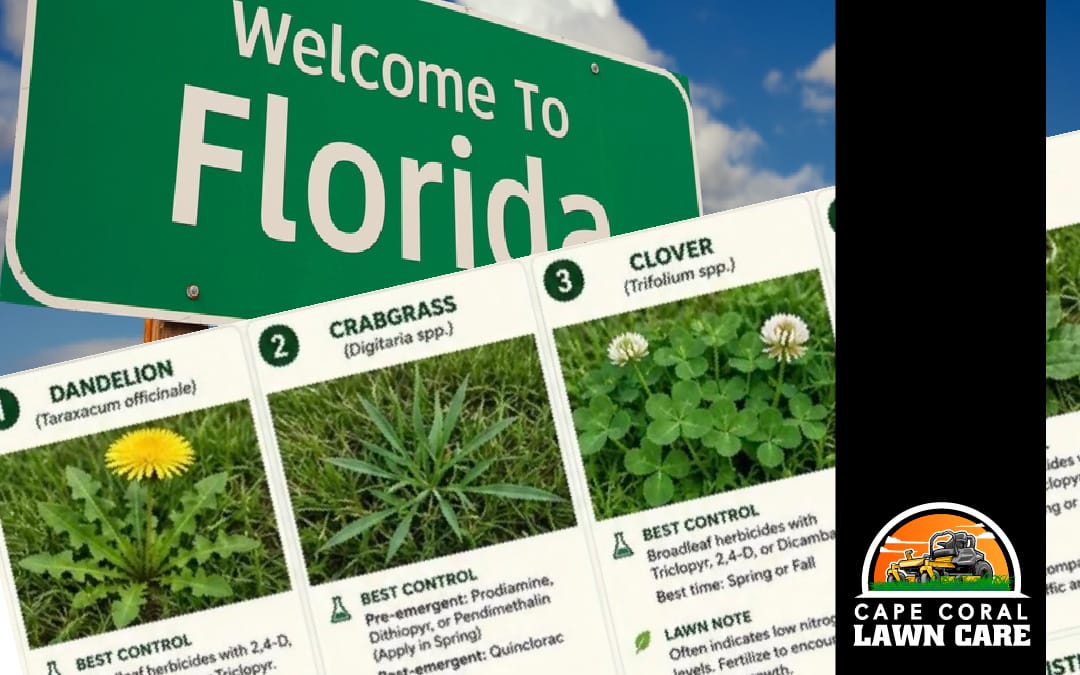
Seeing a few weeds pop up in your Florida lawn is pretty normal, but knowing what you’re looking at can make them much easier to manage.
The trouble starts when a handful of weeds becomes a spreading patch– or when you keep treating the lawn without knowing what type of weed you’re trying to remove.
In Cape Coral’s warm climate, weeds can grow quickly and take advantage of thin grass, bare spots, excess moisture, or other weak areas in the lawn.
That’s why managing Florida lawn weeds is about more than simply finding something that kills them. Long-term control starts with understanding why they appeared, identifying what is actually growing in your yard, and maintaining healthy grass that gives unwanted plants less room to take over.
In this guide, we’ll walk through some of the most common Florida lawn weeds, show you a few easy ways to tell different weed types apart, and explain practical steps you can take to prevent them from becoming a bigger problem.
Why Florida Lawns Tend to Get Weeds
Florida gives weeds a lot of opportunities to grow.
Our warm temperatures allow many plants to remain active for much of the year. Add frequent rainfall, irrigation, strong sunlight, and long growing seasons, and weeds may have far more time to establish than they would in a colder climate.
But weather is only part of the reason weeds thrive.
Weeds are especially good at filling spaces where healthy grass is missing.
If your lawn becomes thin because of heat stress, pests, improper mowing, shade, poor irrigation, or another problem, sunlight can reach the exposed soil. Weed seeds that were already present suddenly have the room and light they need to germinate.
This matters because homeowners sometimes assume weeds cause their lawn to become weak.
Often, the opposite happened first.
The grass became weak, and the weeds took advantage of the opening.
UF/IFAS explains this idea in its Weed Management Guide for Florida Lawns: healthy, dense turf leaves less physical space and sunlight available for weeds to establish.
That means good lawn weed prevention begins with the grass itself.
Some conditions that can encourage weed growth include:
- Thin or stressed turf
- Bare patches
- Mowing too short
- Too much or too little irrigation
- Soil compaction
- Poor drainage
- Pest or disease damage
- Heavy foot traffic
- Incorrect grass selection for the site
- Weak growth in heavily shaded areas
Different weeds also prefer different environments.
Dollarweed and some sedges, for example, often do well in wet areas. Other weeds may thrive in compacted soil, drought-stressed grass, or open sunny patches.
If weeds keep appearing in the same area, look for what may be different about that part of the yard.
The weeds may be giving you a clue.
What Makes a Lawn More Vulnerable to Weeds
A healthy lawn does not guarantee that you’ll never see weeds, but strong turf is much better at competing with them.
Grass becomes more vulnerable when routine Florida lawn care is working against the turf instead of supporting it.
Mowing Too Short
Cutting the lawn extremely short may seem like a way to mow less often, but it can weaken the grass.
Short turf has less leaf surface available for photosynthesis. The soil also receives more direct sunlight, which creates better conditions for weed seeds to germinate.
The proper height depends on your grass species, but one helpful rule is to avoid removing more than about one-third of the grass blade during a single mowing.
Inconsistent Watering
Both overwatering and underwatering can weaken turf.
Too little moisture can create dry, thin areas where weeds establish.
Too much water can also create problems. Constant moisture may encourage weak root systems, fungus, and wet-loving weeds.
The goal is not to keep the lawn permanently wet. It is to provide the amount of water your grass actually needs while taking rainfall and local watering requirements into account.
Poor Grass Coverage
If a section of grass has died from pests, disease, shade, or another problem, weeds often move into that open space quickly.
This is why fixing bare spots matters for more than appearance.
Restoring healthy coverage reduces the room available for unwanted plants.
Compaction and Heavy Traffic
Kids, pets, repeated foot traffic, vehicles, and lawn equipment can gradually compact soil.
Compacted soil makes root development more difficult, weakening the turf. Some weed species handle those conditions better than lawn grass does, giving them a competitive advantage.
The Wrong Grass for the Location
Not every Florida grass thrives in every part of a property.
A grass species that requires full sun may thin dramatically beneath trees. Weed control alone cannot create dense turf if the grass is poorly suited to the location.
In some heavily shaded areas, a groundcover or different landscape design may make more sense than repeatedly trying to force grass to grow.
The big takeaway is simple: common lawn weeds often reveal something about the condition of the lawn around them.
Treating the weed can help, but correcting the condition that allowed it to establish is what improves your chances of keeping it from returning.
Common Florida Lawn Weeds to Watch For
There are many weed species in Florida, so no homeowner needs to memorize every one.
It is useful, however, to recognize a few of the most common categories and plants you may see in a Cape Coral yard.
Weeds in lawns are often grouped into three basic types:
- Grassy weeds
- Broadleaf weeds
- Sedges
Knowing which category a weed belongs to is an important first step because control methods can vary between them.
Crabgrass
Crabgrass in Florida is a common example of a grassy weed.
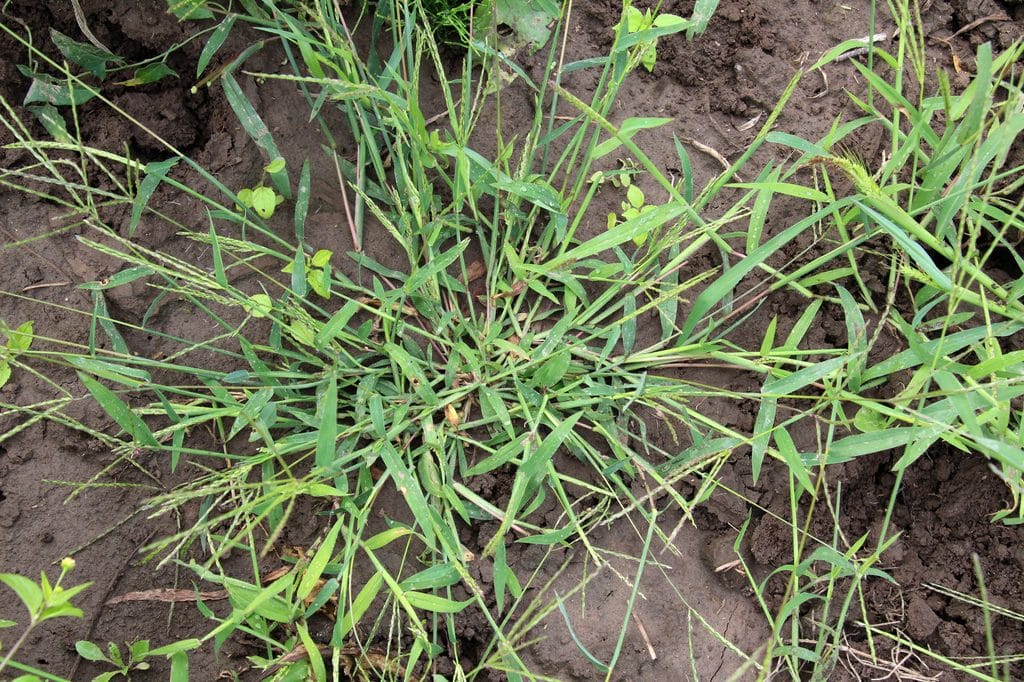
Crabgrass usually grows outward in a spreading pattern and can stand out because its blades and texture look different from the surrounding turf. It tends to take advantage of thin or bare areas where sunlight reaches the soil.
Look for:
- Wider or coarser blades than the surrounding grass
- Low, spreading growth
- Clumps that expand outward
- Seedheads as the plant matures
Crabgrass is an annual weed, meaning individual plants complete their life cycle within a season. However, mature plants can produce seeds that contribute to future weed problems.
That is one reason early identification and prevention matter.
Florida Pusley
Florida pusley is a common broadleaf weed that may appear in lawns and disturbed areas.
It tends to grow low to the ground and produces small white flowers. Its broader leaves make it easier to distinguish from narrow-bladed turfgrass once you know what you’re looking for.
Signs include:
- Low spreading growth
- Broad leaves
- Small clusters of white flowers
- Patches that may expand through weak turf
Florida pusley can be persistent, particularly where the lawn is already stressed or thin.
Dollarweed
Dollarweed is one of the easier weeds to recognize once you’ve seen it.
Its leaves are round and often resemble small coins, which is where the name comes from.
Dollarweed commonly appears in areas that remain wet or receive excess irrigation.
Look for:
- Round, bright-green leaves
- Long stems
- Growth in damp or poorly draining areas
- Patches near irrigation problems or low spots
If dollarweed repeatedly appears in one area, do not focus only on removing the weed.
Check the moisture level too.
You may have an overwatering or drainage issue that is encouraging it.
Nutsedge
Nutsedge looks grass-like from a distance, but it is actually a sedge.
One simple identification trick is the stem.
Many sedges have solid, triangular stems rather than the rounded or flattened stems found on grasses. If you gently roll the stem between your fingers, the shape can sometimes help you identify it.
Nutsedge often grows faster and taller than the surrounding grass, making it noticeable soon after mowing.
Look for:
- Bright green or yellow-green growth
- Faster growth than the turf around it
- Narrow leaves
- Triangular stems
- Preference for moist areas
Pulling nutsedge can be frustrating because some species produce underground structures that allow the plant to return.
Doveweed
Doveweed is another Florida weed that can blend surprisingly well into turf when it is young.
Its leaves may make it look somewhat grass-like from a distance, but closer inspection reveals a different growth pattern.
Doveweed tends to favor moist areas, and it can become troublesome during Florida’s wet growing season.
This is another reason homeowners should not assume that every narrow-leaved plant growing in the lawn is simply another grass.
Spotted Spurge
Spotted spurge is a low-growing broadleaf weed that often spreads close to the soil.
It may appear around thin turf, sidewalks, driveways, and other hot, open areas.
The plant develops branching stems and small leaves, often forming a mat that spreads outward.
Because it grows low, mowing alone may not remove it.
Broadleaf Weeds vs. Grassy Weeds
You do not need expert botanical knowledge to make a useful first distinction.
Broadleaf weeds usually have:
- Wider leaves
- Net-like leaf veins
- More noticeable flowers
- Growth that looks very different from grass
Examples can include Florida pusley, clover-type plants, plantain, and spurge.
Grassy weeds generally have:
- Long, narrow blades
- Parallel veins
- Growth that resembles turfgrass
- Jointed stems and grass-like seedheads
Crabgrass and goosegrass are examples.
Sedges can look like grasses too, but their stem structure and growth habits are different.
UF/IFAS offers much more detailed weed identification and management information in its Florida lawn weed guide, which is especially useful before choosing any herbicide.
If you’d like another homeowner-friendly breakdown, our guide to Florida lawn weeds and practical control tips goes deeper into several weeds Cape Coral homeowners commonly encounter.
How to Tell a Weed From Your Grass
Some weeds announce themselves immediately.
Others blend into the lawn so well that homeowners do not notice them until the patch gets larger.
If something unfamiliar starts growing in the yard, compare it to the grass surrounding it.
Look at several characteristics.
Leaf Shape
Are the leaves broad and rounded?
Long and narrow?
Thicker or shinier than your turf?
Leaf shape is one of the easiest differences to notice.
Color
A weed may be:
- Lighter green
- Darker green
- Blue-green
- Yellow-green
A patch that looks unusually bright compared with the rest of the lawn may be a different plant species.
Growth Pattern
Does it grow upright?
Spread along the ground?
Form a clump?
Run outward through stems or runners?
Growth habit can narrow down the possibilities quickly.
Height
Some weeds grow much faster than turfgrass.
If certain plants tower above the lawn only a few days after mowing, inspect them more closely.
Flowers or Seedheads
Flowers and seedheads are among the easiest identification features.
Take a clear photo before mowing or pulling the plant.
That can make identification much easier later.
Stem Shape
This is particularly useful for distinguishing grasses from sedges.
Some sedges have distinctly triangular stems.
Where It Is Growing
Location can provide another clue.
A weed repeatedly appearing in soggy areas may favor moisture.
One growing mainly in bare sunny patches may prefer disturbed, exposed soil.
A plant under heavy shade may be taking advantage of turf that cannot grow densely there.
Before beginning weed control in Florida, identify the plant as accurately as possible.
UF/IFAS stresses this point because herbicides differ in what they control and which turfgrass species can safely tolerate them. Its Florida Homeowner Herbicide Guide is a helpful reference for understanding why product selection should follow weed and grass identification– not come before it.
And because irrigation affects both turf health and certain weed problems, it is worth making sure your watering routine is not contributing to the issue. Check out our guide to the Cape Coral watering schedule for more information about local watering days, timing, and requirements.
How to Prevent Florida Lawn Weeds Before They Take Over
The most effective weed strategy is not waiting until the lawn is full of weeds.
Prevention begins with maintaining enough healthy turf to make weed establishment difficult.
Think of your healthy grass as competition for weeds.
When the lawn is dense, weed seeds receive less sunlight and have less open soil available for establishment.
When turf is thin, weeds have very little competition.
UF/IFAS makes this point in its Best Management Practices for Your Lawn: matching mowing, irrigation, fertilization, and other maintenance practices to the needs of the grass helps produce stronger turf while reducing unnecessary inputs.
Here are practical ways to make lawn weed prevention part of your normal maintenance routine.
Mow at the Right Height
Avoid scalping the lawn.
The correct mowing height depends on the turf species, but grass that is repeatedly cut too low often becomes thinner and more stressed.
Keep mower blades sharp too.
Dull blades tear rather than cut the grass cleanly, which adds unnecessary stress.
Water Based on Need
Do not water simply because the irrigation timer says to.
Account for rainfall and observe the lawn for signs that it actually needs moisture.
Too little water can create thin turf.
Too much can encourage shallow roots, fungus, and wet-loving weeds.
Fix Bare Spots Early
If grass dies, determine why before simply reseeding or replacing it.
Possible causes include:
- Pest damage
- Disease
- Poor irrigation
- Shade
- Soil compaction
- Drainage
- Foot traffic
Once the underlying problem is corrected, restoring turf coverage can reduce the open space available to weeds.
Keep Lawn Equipment Clean
Weed seeds and plant fragments can hitch a ride on mowers, trimmers, and other equipment.
If you work in a heavily weed-infested section, cleaning equipment before moving into a clean area can help reduce accidental spread.
Avoid Letting Weeds Go to Seed
A small weed problem can become next season’s much larger problem if mature plants are allowed to produce seeds.
When practical, remove isolated weeds before they reach that point.
For a small infestation, hand-pulling may be perfectly reasonable.
Make sure you remove enough of the root system to prevent easy regrowth.
Pay Attention to What the Weeds Are Telling You
Repeated weeds may reveal a lawn condition that needs correction.
For example:
- Wet-loving weeds may suggest excess moisture.
- Weeds in compacted areas may point to soil problems.
- Weeds under trees may indicate turf that is struggling with shade.
- Weeds in bare spots may show that the grass has not recovered from previous damage.
Fixing those conditions gives you better long-term results than repeatedly removing the visible plants.
If you want a deeper look at the bigger weed-management picture, our Master Weeds and Weed Control guide covers additional identification and lawn-care strategies.
What About Pre-Emergent Weed Control?
Pre-emergent herbicides can be useful for preventing certain annual weeds before they emerge.
The key word is “before.”
They work by interfering with weed development during germination and early growth stages. Once the targeted weeds are already mature and visible, a pre-emergent application generally will not solve the existing infestation.
Timing therefore matters.
The target weed also matters.
One pre-emergent product does not necessarily prevent every weed in Florida.
Homeowners should also be cautious when planning to establish new grass from seed because some pre-emergent herbicides can interfere with desirable turf germination or rooting.
Always read and follow the label.
What About Post-Emergent Herbicides?
Post-emergent products are used on weeds that are already growing.
Again, identification comes first.
The herbicide must be:
- Labeled for the target weed
- Safe for the turfgrass species
- Applied at the correct rate
- Used under appropriate weather conditions
- Applied according to all label directions
Products that kill broadleaf weeds may not control grassy weeds.
A herbicide safe for one Florida turfgrass may injure another.
More product is not better.
The label is the law, and homeowners should never increase the concentration because they think it will produce faster results.
For limited weed problems, targeted treatment may also make more sense than treating the entire yard.
The goal of weed control Florida homeowners use should be to manage the actual problem while maintaining healthy turf– not simply applying as much herbicide as possible.
When Florida Lawn Weeds Need More Than DIY Control
A few weeds do not necessarily require professional treatment.
However, if the problem keeps returning, spreads across a large part of the lawn, or resists your efforts to control it, it may be time to look deeper.
Recurring weeds can point to underlying such as:
- Weak turf
- Poor grass selection
- Compacted soil
- Excessive shade
- Irrigation problems
- Poor drainage
- Pest damage
- Disease
- Incorrect mowing
- Improper herbicide selection
This is where random treatments can become expensive.
You buy one weed killer.
Nothing happens.
You try another.
The lawn starts looking stressed.
The weeds return anyway.
The problem may not be a lack of products. It may be that the weed was misidentified or the lawn conditions continue giving it an advantage.
Professional lawn care can help by looking at the whole situation.
That may include:
- Identifying the weed species
- Identifying the turfgrass
- Evaluating lawn density
- Checking watering habits
- Looking for pest or disease problems
- Considering drainage and soil conditions
- Recommending appropriate treatment options
Professional Florida lawn care should not simply be about removing whatever green plant does not belong.
The better goal is creating a lawn that stays healthier and gives weeds fewer opportunities to return.
Long-Term Weed Control Starts With the Lawn
There is no realistic way to guarantee that a Florida lawn will never grow another weed.
Seeds arrive through wind, animals, soil, equipment, sod, neighboring properties, and many other routes.
The goal is management.
Keep the turf healthy enough that weeds have difficulty establishing, identify problems while they are small, and use control methods appropriate for the weed and lawn.
A successful long-term routine includes:
- Proper mowing
- Appropriate irrigation
- Responsible fertilization
- Pest and disease monitoring
- Bare-spot repair
- Weed identification
- Early intervention
- Targeted treatment when necessary
Consistency matters more than chasing a perfectly weed-free lawn with constant chemical applications.
If weeds continue returning in the same areas, focus on why the grass cannot compete there.
That question often leads to a better solution.
Dealing With Florida Lawn Weeds That Keep Coming Back?
Florida lawn weeds are part of maintaining a yard in a warm, active growing environment, but they do not have to take over your property.
Learning to recognize common weeds like crabgrass, Florida pusley, dollarweed, nutsedge, and doveweed gives you a better starting point.
From there, good lawn maintenance can help create thicker turf and reduce the open areas weeds use to establish.
When weeds do appear, identify them before choosing a treatment. And if the same problem keeps returning, look beyond the weed itself to see what may be weakening the surrounding lawn.
Dealing with Florida lawn weeds can be frustrating, especially when they keep coming back. If you’re not sure what’s growing in your lawn or how to keep it under control, our team here at Cape Coral Lawn Care can help.
Reach out to us today, and we’ll help you get your lawn back on track with a healthier, more consistent approach to weed control and lawn maintenance.
FAQs
Q: What are some common Florida lawn weeds?
A: Florida lawns can develop many types of weeds. Crabgrass is a common grassy weed, while Florida pusley, dollarweed, and spurge are examples of broadleaf weeds. Nutsedge is another common lawn problem but belongs to a different plant group called sedges. The weeds present in your yard depend on grass type, soil, moisture, sunlight, and other growing conditions.
Q: Why does my Florida lawn keep getting weeds?
A: Weeds often establish more easily when turf becomes thin or stressed or when bare soil is exposed. Mowing too short, irrigation problems, compaction, shade, pests, disease, and other lawn issues can all reduce turf density and create opportunities for weeds.
Q: How can I prevent weeds from taking over my lawn?
A: Start with consistent Florida lawn care, including proper mowing, watering, fertilization, and maintaining good grass coverage. Correct bare areas and underlying lawn problems when possible, and address weeds while infestations are still small.
Q: When should I consider professional weed control?
A: Professional help may be worth considering if weeds repeatedly return, spread across a large part of the lawn, resist previous treatments, or are difficult to identify. A lawn professional can evaluate both the weeds and the conditions that may be allowing them to thrive.