
If your lawn dries out quickly or seems to struggles despite regular care sandy soil could be the reason.
This is a common challenge for Cape Coral homeowners. You may water regularly, fertilizer, and reseed thin areas– only to see the lawn dry out again, lose color, or grow unevenly. The problem may not be the amount of effort you’re putting in. It may be how quickly water and nutrients move through the soil beneath your grass.
The good news is that sandy soil is not automatically bad soil. Like any soil type, it simply requires a different approach to lawn care. It drains well and is less likely to stay waterlogged than heavy clay. However, it requires a different lawn care approach because it does not hold moisture or nutrients for very long.
In this guide, we’ll explain how sandy soil affects grass growth, how to recognize soil-related lawn problems, and what Cape Coral homeowners can do to gradually build a healthier, stronger lawn.
Why Sandy Soil Affects Lawn Growth
Soil is made up of mineral particles, organic material, water, and air. The size of those mineral particles plays a major role in how the soil behaves.
Sand particles are larger than clay or silt particles. Because the spaces between them are also larger, water moves through sandy soil very quickly.
That fast drainage can be helpful during Cape Coral’s rainy periods. Water is less likely to sit around grass roots for long stretches, which can reduce some drainage and root-rot problems.
The trade-off is that sandy soil may dry out soon after the rain stops.
It also tends to hold fewer nutrients than heavier soils. Water can carry soluble nutrients below the grass’s root zone before the lawn has time to use them. This process is often referred to as leaching.
As a result, lawns growing in sandy soil may experience:
- Faster moisture loss
- Lower organic matter levels
- Reduced nutrient retention
- More frequent drought stress
- Uneven grass growth
- Shallow or weakened roots
- Faster fertilizer loss after heavy rain
UF/IFAS explains in its guide to working in your Florida soil that Florida soil conditions can vary widely, especially in developed neighborhoods where construction, fill material, and compaction may have changed the original soil.
That means two Cape Coral lawns on the same street may still behave differently.
One property may drain almost too quickly, while another has compacted areas where rainwater pools. Understanding your specific lawn is more useful than assuming every sandy yard needs the exact same treatment.
Common Signs Your Lawn Is Struggling With Sandy Soil
It’s easy to blame thin or discolored grass on fertilizer, pests, or the grass variety itself. But poor soil conditions may be contributing to the problem.
Common signs include:
- Grass drying out shortly after irrigation
- Thin or pale turf
- Patchy growth
- Bare soil showing between grass blades
- Uneven color across the yard
- Fertilizer results that seem short-lived
- Grass struggling during hot, dry weather
- Newly planted areas failing to establish evenly
If you keep asking, “Why won’t my grass grow?” take a closer look at how quickly the soil dries and whether the roots are developing properly.
You can perform a simple observation after irrigation. Check the soil a few hours after watering, then check it again the following day. If the upper root zone dries almost immediately, your lawn may be losing moisture too quickly.
You should also compare healthy and struggling areas.
Does the thinner grass receive more sun? Is it located near a driveway where heat reflects onto the lawn? Is the soil looser, more compacted, or visibly sandier than in healthier areas?
The right grass for sandy soil can still struggle if irrigation coverage is poor, roots are shallow, or the lawn is planted in the wrong light conditions.
Before adding more fertilizer or seed, identify whether the problem is related to:
- Soil quality
- Irrigation
- Compaction
- Grass selection
- Shade
- Pests or disease
- Erosion
- Mowing practices
Adding products without identifying the cause may create temporary color change without improving the lawn’s long-term health.
Improving Sandy Soil for Healthier Grass
Improving sandy soil does not usually mean removing it and replacing the entire yard.
The more practical goal is to gradually increase organic matter, strengthen root development, improve nutrient management, and help the soil retain moisture longer.
Improving sandy soil takes time. Healthy soil develops through consistent care rather than one dramatic application. For established lawns, improvements should be introduced carefully so the existing grass is not smothered or damaged.
Useful strategies may include:
- Applying a light compost topdressing
- Returning grass clippings to the lawn
- Correcting compaction
- Watering deeply and appropriately
- Fertilizing based on actual lawn needs
- Repairing bare areas
- Choosing Florida-adapted grass
- Monitoring soil pH and nutrient levels
A helpful sandy-soil lawn guide also recommends building healthier soil, watering efficiently, and choosing lawn varieties suited to fast-draining conditions. You can review those suggestions in Tips for Maintaining Lawns on Sandy Soil.
The key is improving the soil without creating a new problem.
For example, dumping a thick layer of compost or topsoil over an established lawn may cover grass blades, interfere with sunlight, and leave an uneven surface. Any topdressing should be thin, evenly distributed, and appropriate for the condition of the lawn.
How Compost Helps Sandy Soil
Using compost for sandy soil can support gradual improvement because compost adds organic material.
Adding organic matter can help sandy soil:
- Retain moisture longer
- Hold nutrients more effectively
- Support beneficial soil organisms
- Improve soil structure
- Encourage healthier root development
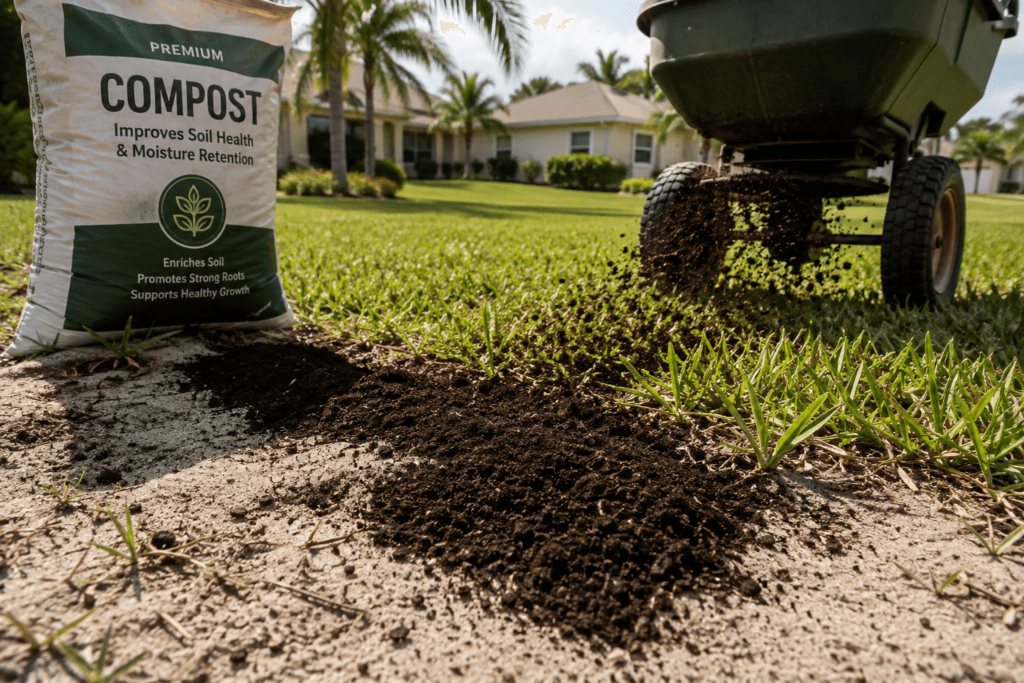
For an established lawn, compost may be applied as a thin topdressing rather than a heavy layer. The grass blades should remain visible after application.
For a lawn renovation or new planting area, organic material can sometimes be incorporated more thoroughly before grass is installed. This gives homeowners an opportunity to improve the root zone before seed, sod, or plugs are introduced.
The UF/IFAS resource on soil health and fertility in Florida-Friendly landscapes discusses how organic materials can improve nutrient cycling, water-holding ability, and overall soil health.
Even so, compost is not an instant fix.
Organic matter breaks down over time, especially in Florida’s warm climate. Maintaining healthier soil may require occasional additions, responsible fertilization, and continued attention to the lawn’s response.
It is also important to know what you are applying. Use mature, properly finished compost rather than material that is still actively decomposing or contains contaminants.
Why Soil Testing Should Come First
Before applying fertilizer, lime, or soil amendments, consider testing the soil.
A soil test can provide information about:
- Soil pH
- Phosphorus levels
- Potassium levels
- Calcium and magnesium
- Possible nutrient imbalances
- Whether lime is recommended
Yellow or thinning grass doesn’t always mean your lawn needs more fertilizer.
The soil may already contain enough of a particular nutrient. The real problem could be pH, root stress, compaction, irrigation, or disease.
Applying fertilizer without understanding the soil may:
- Waste money
- Encourage excessive top growth
- Increase nutrient leaching
- Create uneven lawn color
- Contribute to runoff
- Fail to correct the real problem
Soil pH is especially important because it affects nutrient availability. Even when nutrients are present, grass may struggle to use them if the pH is outside the appropriate range.
A soil test does not diagnose every lawn issue. It will not identify chinch bugs, fungus, poor sprinkler coverage, or improper mowing. But it gives you useful information before you begin changing the soil.
Not sure what’s happening beneath your lawn? Read our guide on why you should test your soil to learn how soil analysis can improve your lawn care plan.
Good lawn soil improvement starts with understanding what the lawn actually needs– not guessing.
Long-Term Lawn Care Tips for Sandy Soil
Long-term success starts with consistent lawn care and maintenance.
One-time treatments may create short-term improvements, but they rarely solve every issue. Watering, mowing, fertilization, grass selection, and soil care must work together.
Water Deeply Without Watering Constantly
Because sandy soil drains quickly, homeowners may assume they need to water every day.
Frequent shallow watering encourages weak, shallow roots. Grass becomes dependent on moisture near the surface and may struggle quickly when the soil dries.
Established lawns generally benefit from deeper, less frequent watering based on visible signs of need and local watering rules.
Signs that grass may need water include:
- Folding grass blades
- A blue-gray color
- Footprints remaining visible
- Dry soil within the root zone
The goal is to moisten the root zone without watering until runoff occurs.
Newly planted seed, sod, or plugs have different establishment needs. Young grass may need more frequent moisture until roots begin developing, but irrigation should gradually transition toward a deeper, less frequent schedule.
Choose Grass That Matches the Property
There isn’t one grass variety that’s best for every Cape Coral lawn.
Your choice should also account for:
- Sun exposure
- Shade
- Foot traffic
- Irrigation availability
- Maintenance preferences
- Salt exposure
- Desired appearance
Florida-adapted warm-season grasses have different strengths.
Bahiagrass is often valued for drought tolerance and its ability to grow in lower-fertility soil, although it has a coarser appearance. Bermudagrass handles full sun and traffic well but may require more mowing and nutrition. St. Augustinegrass is common in Cape Coral and can tolerate some shade, but it generally needs consistent care. Zoysiagrass can form dense turf, though its needs vary by cultivar.
Matching the grass to the site is more effective than choosing based on appearance alone.
Mow to Support Root Health
Mowing too short makes sandy-soil lawns even more vulnerable to heat and moisture loss.
Taller grass blades shade the soil and support deeper root development. The correct mowing height depends on the grass variety, but homeowners should avoid removing more than one-third of the blade at once.
Sharp mower blades also matter.
Dull blades tear grass, leaving frayed tips that lose moisture and become more vulnerable to stress. Clean cuts allow the lawn to recover more efficiently.
Fertilize Carefully
Sandy soil may lose nutrients quickly, but that does not mean fertilizer should be applied heavily.
Large applications may increase leaching rather than feeding the grass more effectively.
A thoughtful fertilization plan may include:
- Slow-release nitrogen
- Applications timed to active growth
- Product selection based on grass type
- Soil-test recommendations
- Local fertilizer rules
- Avoiding treatment before heavy rain
For many lawns, smaller properly timed applications are more useful than one large feeding.
Return Grass Clippings
When grass clippings are short and evenly distributed, they can usually remain on the lawn.
Clippings break down and return small amounts of nutrients and organic material to the soil. They do not normally create thatch when the lawn is mowed properly.
This is a simple way to support Florida lawn care without purchasing another product.
Setting Realistic Expectations for Lawn Growth
Improving a lawn in sandy soil is a gradual process.
Compost will not transform the soil overnight. Fertilizer cannot correct poor irrigation. Seed cannot establish successfully if the grass type is wrong for the site or if the soil surface dries out repeatedly.
Lawn establishment depends on several factors:
- Grass species
- Soil quality
- Temperature
- Rainfall
- Irrigation
- Sunlight
- Seed-to-soil contact
- Pest and disease pressure
- Consistent maintenance
This is why two lawns planted on the same day may develop at different rates.
Homeowners should monitor progress across the growing season rather than expecting immediate full coverage. Look for gradual improvements such as:
- More even color
- Fewer dry patches
- Improved turf density
- Better recovery after heat
- Stronger root development
- Less irrigation runoff
If you are waiting for a newly planted area to fill in, our guide on how long grass seed takes to grow explains how soil, shade, weather, and grass type influence the timeline.
Patience does not mean ignoring problems. It means giving appropriate treatments enough time to work while continuing to watch for signs that the lawn needs a different approach.
Build Better Soil Instead of Chasing Quick Fixes
Sandy soil affects how quickly water drains, how long nutrients remain available, and how easily grass roots establish.
That can make lawn care more challenging, but it does not make a healthy Cape Coral lawn impossible.
The most effective approach is to build better soil gradually through organic matter, responsible watering, careful fertilization, appropriate grass selection, and consistent maintenance.
Before spending more money on fertilizer or lawn products, take time to identify what’s actually causing the problem. Test the soil, inspect the irrigation, evaluate the grass type, and look for compaction or environmental stress.
If you’re struggling with sandy soil or an unhealthy lawn, Cape Coral Lawn Care can help. Our team can evaluate your soil, identify the underlying issues, and create a customized plan to help your lawn thrive. Contact us today to schedule your professional lawn evaluation.
FAQs
Q: Why is sandy soil common in Florida?
A: Much of Florida naturally has sandy soil formed from weathered rock and marine materials. Sandy soil drains quickly and generally holds less moisture and fewer nutrients than soils containing more clay or organic material.
Q: How can I improve sandy soil for my lawn?
A: Adding organic matter through carefully applied compost, returning grass clippings, improving irrigation, correcting compaction, and following an appropriate fertilization plan can gradually improve soil health.
Q: Why won’t my grass grow in sandy soil?
A: Grass may struggle because sandy soil loses moisture and nutrients quickly. Poor grass selection, inadequate sunlight, uneven irrigation, compaction, pests, or disease may also contribute to slow or patchy growth.
Q: Should I test my soil before fertilizing?
A: Yes. A soil test can provide information about pH and certain nutrient levels, helping you choose appropriate treatments instead of applying fertilizer based only on appearance.