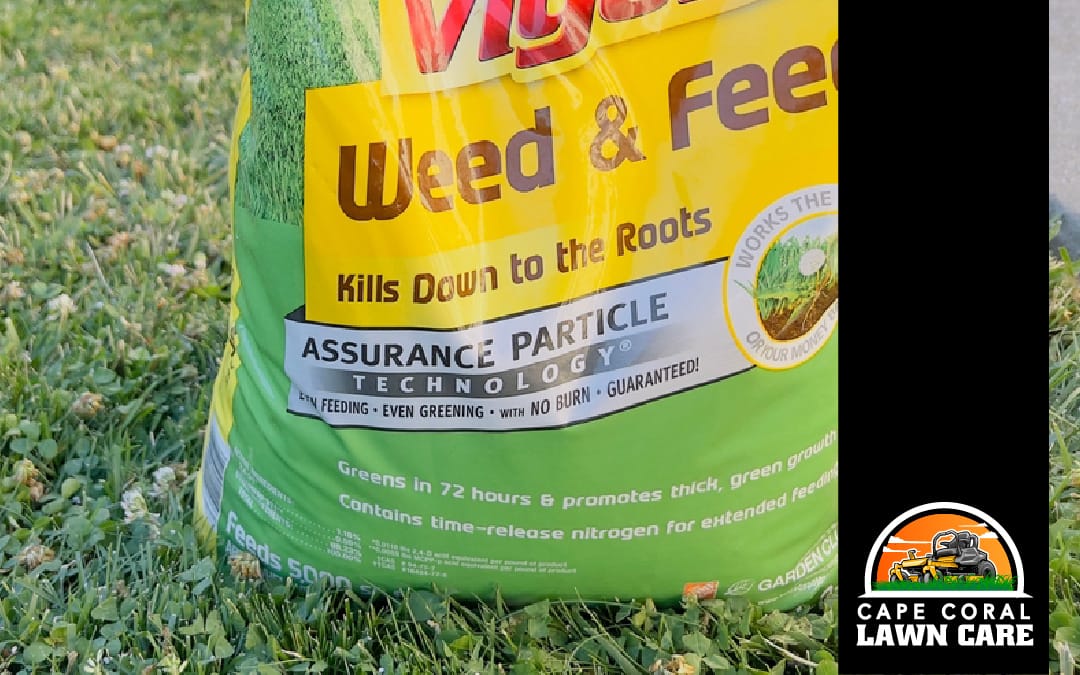
Many homeowners reach for weed and feed products hoping to eliminate weeds and fertilize their lawn in one simple step.
It sounds convenient: spread one product, tackle two problems, and enjoy your lawn. But Florida’s climate often makes lawn care more complicated than that.
Here’s where things get complicated: your lawn may need fertilizer at one point in the season and weed control at another.
When both treatments are packaged together, you lose the flexibility to apply each one when your lawn actually needs it.
That matters here in Cape Coral, where heat, seasonal rain, sandy soil, and local fertilizer rules can all affect when lawn treatments should be used.
In this guide, we’ll explain how weed and feed products work, when they may be appropriate, and why separate weed control and lawn fertilization are often the smarter choice for a healthier Florida lawn.
What Are Weed and Feed Products?
Weed and feed products combine two different lawn treatments into one application:
- A fertilizer designed to provide nutrients to the grass
- An herbicide designed to prevent or control weeds
The “feed” portion usually contains nutrients such as nitrogen, potassium, and sometimes phosphorus. These nutrients support grass growth, color, and root development.
The “weed” portion may contain either a pre-emergent or post-emergent herbicide.
A pre-emergent herbicide works by stopping certain weed seeds from developing successfully. It must be applied before the target weeds germinate.
A post-emergent herbicide is intended to control weeds that are already growing in the lawn.
At first glance, combining these treatments seems like an obvious time-saver. The problem is that the lawn’s feeding schedule and the weeds’ growth schedule do not always line up.
UF/IFAS explains this issue clearly in its guide, Weed & Feed: Is It Helpful or Hurtful?. The article notes that a lawn may need pre-emergent weed control before the grass is actively growing enough to use fertilizer effectively.
In other words, one part of the product may be properly timed while the other is not.
Florida lawns also behave differently from lawns in cooler northern climates. Warm-season grasses, year-round weed pressure, heavy rain, and sandy soils make one-size-fits-all treatments especially difficult to use correctly. What works well in northern states doesn’t always translate to Florida lawns.
Why Timing Matters in Florida
Success with both fertilizer and weed control depends heavily on timing..
Herbicides are most effective when they are applied at the correct stage of a weed’s growth cycle. Fertilizer works best when the grass is actively growing and able to absorb and use the nutrients.
Those two windows may not happen at the same time.
For example, pre-emergent weed control must be applied before weed seeds germinate. Waiting until weeds are already visible means the pre-emergent portion may no longer solve the immediate problem.
Fertilizer, on the other hand, should generally be applied when the lawn is actively growing. Feeding stressed, dormant, or slow-growing turf may waste product and increase the risk of nutrient runoff.
Cape Coral homeowners must also consider:
- Heavy seasonal rainfall
- High summer temperatures
- Sandy soil that loses nutrients quickly
- Local fertilizer restrictions
- The grass species growing in the yard
- The specific weeds being targeted
These factors make a customized approach much more reliable than following the same calendar every year.
The label on the product matters too. Weed and feed formulas are not interchangeable. Different products contain different herbicides, and some may not be suitable for every Florida grass type.
Before applying any Florida lawn fertilizer or herbicide, homeowners should read the entire label and confirm that the product is safe for their turf.
Are Weed and Feed Products the Best Choice?
Weed and feed products aren’t necessarily a bad choice in every situation– but they aren’t the best solution for every lawn either. There may be times when the lawn needs fertilizer and has a widespread weed problem that can be treated safely with the same product.
However, that does not mean they are the best choice for every yard.

Imagine that your lawn has only a few weeds growing near the driveway. Applying a combination product across the entire property means spreading herbicide over large areas that may not need it.
That can be wasteful, and it may expose nearby landscape plants to unnecessary herbicide.
Different weeds also respond to different treatments. A product labeled for one type of broadleaf weed may do very little for sedges, grassy weeds, or another species.
That is why there is no single best weed killer for lawns in every situation. The best treatment depends on:
- The weed species
- The grass type
- The size of the infestation
- The time of year
- Whether the weeds have already emerged
- The health of the surrounding turf
Accurate weed identification should come before treatment.
If the weed problem is limited, spot treatment may be more appropriate than spreading herbicide across the entire lawn.
If weeds are widespread, the lawn may also have a maintenance problem that needs to be corrected– such as mowing too short, overwatering, poor drainage, or thin turf.
Killing the weeds without addressing why they appeared often leads to the same problem returning.
When a Weed and Feed Product May Make Sense
A weed and feed product may be a good fit if:
- The lawn genuinely needs fertilizer
- The target weeds are covered by the product label
- The treatment is safe for your grass species
- The timing is appropriate for both treatments
- Local fertilizer rules allow the application
- Weather conditions are suitable
- The product can be applied without affecting nearby plants or waterways
That is a much narrower situation than many homeowners expect.
Convenience should not be the only reason to choose a lawn product. It also needs to match the lawn’s actual condition.
If those factors do not line up, treating weeds and feeding the lawn separately gives you much more control.
The Benefits of Separate Weed Control and Fertilization
Separating weed control from lawn fertilization allows each treatment to be used when it will be most effective.
That flexibility offers several important benefits.
More Accurate Timing
You can apply pre-emergent weed control before targeted weeds begin growing, then fertilize later when the grass is actively using nutrients.
You are not forced to feed the lawn simply because weed treatment is needed.
More Targeted Weed Control
Separate treatment makes it possible to address only the affected areas.
Instead of broadcasting herbicide across the entire yard, you may be able to spot-treat individual weeds or limited patches. This reduces unnecessary product use and lowers the risk of affecting healthy grass or nearby landscaping.
Better Fertilizer Selection
Your lawn’s nutrient needs may not match the fertilizer blend contained in a combination product.
Using a separate fertilizer allows you to select a formula based on:
- Your grass type
- Soil conditions
- Growth stage
- Seasonal needs
- Local requirements
UF/IFAS encourages homeowners to follow the principle of Right Fertilizer, Right Place. That means choosing the correct nutrients, using the proper amount, and applying them only when and where they are needed.
Easier Troubleshooting
When several treatments are combined, it may be difficult to determine what helped or harmed the lawn.
Separate applications also make it much easier to identify what’s working– and what isn’t. You can see whether the weed treatment worked, whether the grass responded to fertilizer, and whether another part of the routine needs to change.
Why a Customized Lawn Care Plan Works Better
Professional lawn care providers often evaluate the entire yard before recommending treatments.
They may consider weed species, turf type, irrigation, soil conditions, mowing habits, and seasonal stress. This produces a more individualized plan than simply applying the same bagged product everywhere.
Want to build a healthier lawn year-round? Read our guide on how to create a lawn care routine that works for your Cape Coral yard.
Best Practices for a Healthy Florida Lawn
The healthiest lawns are often the best defense against weeds.
Thick grass leaves less open space for weeds to establish. Strong roots also help the lawn handle heat, rainfall changes, foot traffic, and temporary stress.
A complete lawn care plan should include more than weed killer.
Mow at the Proper Height
Cutting grass too short weakens it and exposes more soil to sunlight. That gives weed seeds a better opportunity to germinate.
Different Florida grasses require different mowing heights, so identify your turf type before lowering the mower deck.
Never remove more than one-third of the grass blade in a single mowing. Scalping the lawn can cause stress and create thin areas where weeds take hold.
Water According to the Lawn’s Needs
Frequent shallow watering encourages weak roots and may support certain weeds.
Watering more deeply and less often generally encourages roots to grow farther into the soil. Irrigation should also be adjusted after rainfall so the lawn is not receiving water it does not need.
Overwatering is particularly important to avoid in Cape Coral because it can contribute to fungus, weak turf, and weeds that thrive in moist soil.
Use Fertilizer Carefully
The Florida lawn fertilizer you choose should match your grass and soil conditions.
Slow-release nitrogen is often preferred for routine feeding because it provides nutrients gradually and reduces the risk of sudden growth or fertilizer burn.
Homeowners should also avoid fertilizing before heavy rain. Rain may carry nutrients away before the grass can use them, potentially sending fertilizer into storm drains or waterways.
For a deeper look at fertilizer selection and timing, read our guide on how to fertilize for a strong Florida lawn.
Monitor the Lawn Regularly
Walk through the yard every week or two and look for:
- New weeds
- Thin grass
- Bare patches
- Yellow or brown areas
- Standing water
- Uneven growth
- Pest activity
Early detection makes most lawn problems easier to manage.
A few weeds can often be addressed before they produce seeds or spread across the yard. Waiting until the infestation is extensive usually requires more time, treatment, and repair.
Use Pre-Emergent Weed Control Strategically
Pre-emergent products can be useful for stopping certain annual weeds before they emerge.
However, pre-emergent herbicides do not control every weed, and they generally do not kill mature weeds that are already growing.
They can also affect desirable grass seed germination. If you plan to seed or repair part of the lawn, the timing of a pre-emergent application must be considered carefully.
Effective pre-emergent weed control depends on selecting a product labeled for the target weed and applying it at the proper time.
Again, the product label is the law. Follow all application rates, timing instructions, safety precautions, and restrictions.
When to Call a Lawn Care Professional
Some lawn problems can be managed with better mowing, watering, and a small amount of targeted weed control.
Others continue returning no matter what the homeowner tries.
Professional help may make sense if:
- Weeds spread rapidly
- The same weeds return every season
- Large parts of the lawn are thin or bare
- You cannot identify the weeds
- Fertilizer produces uneven results
- The lawn remains weak despite routine care
- Several problems seem to be happening at once
- You are unsure which products are safe for your grass
A lawn professional can identify the weeds, assess the health of the turf, and determine whether the problem is related to maintenance, soil, irrigation, pests, or disease.
They can also develop a customized lawn fertilization schedule rather than treating every lawn the same way.
This can help homeowners avoid unnecessary herbicide applications, wasted fertilizer, and products that do not address the real problem.
What’s Our Verdict on Weed and Feed Products?
Weed and feed products sound convenient because they promise two lawn treatments in one step.
But Florida lawns are rarely that simple.
The best time to control weeds may not be the best time to fertilize. Your lawn may need nutrients without herbicide, or weed treatment without fertilizer. The weeds in your yard may also require a treatment that is not included in the combination product you selected.
For many Cape Coral lawns, separate weed control and fertilization provide more accurate timing, better product selection, and fewer unnecessary applications.
The goal should not be to apply the most products. It should be to give the lawn exactly what it needs– at the time it can use it most effectively.
Not sure if weed and feed products are right for your lawn?
Our team here at Cape Coral Lawn Care can evaluate your yard and recommend the very best weed control and fertilization plan for your grass type and growing conditions.
Contact us today for a professional lawn evaluation and personalized treatment plan for your weed and fertilize needs– and anything else we can help with.
FAQs
Q: What are weed and feed products?
A: Weed and feed products combine an herbicide and fertilizer into one application. Depending on the product, the herbicide may help prevent certain weeds or control weeds that are already growing.
Q: Are weed and feed products good for Florida lawns?
A: They may work in some situations, but many Florida lawns benefit more from separate weed control and fertilization. Separate treatments allow each product to be selected and applied at the proper time.
Q: What is pre-emergent weed control?
A: Pre-emergent weed control helps prevent certain weeds by interfering with their development before they emerge. It does not control every weed and generally will not kill mature weeds that are already visible.
Q: When should I fertilize my Florida lawn?
A: Fertilizer should generally be applied when the grass is actively growing and able to absorb nutrients. The exact timing depends on the grass type, local conditions, weather, and current fertilizer regulations.